

Introduction: Why Princess Kate’s Warning Matters Now More Than Ever
The Princess of Wales, Catherine, gave a poignant speech in October 2025 that struck a chord with parents all across the world. She cautioned that excessive technology use is severing family ties in her essay “The Power of Human Connection in a Distracted World,” which she co-wrote with Harvard Medical School professor Robert Waldinger. Screens, tablets, and smartphones have become ubiquitous distractions that divert our focus from the people in front of us. Princess Kate did not completely denounce technology. She recognized its advantages. However, she brought attention to a rising issue: families who physically sit together but are mentally absent. During supper, phones are buzzing. While kids tell stories, parents browse. Instead of playing outside, children withdraw inside games.

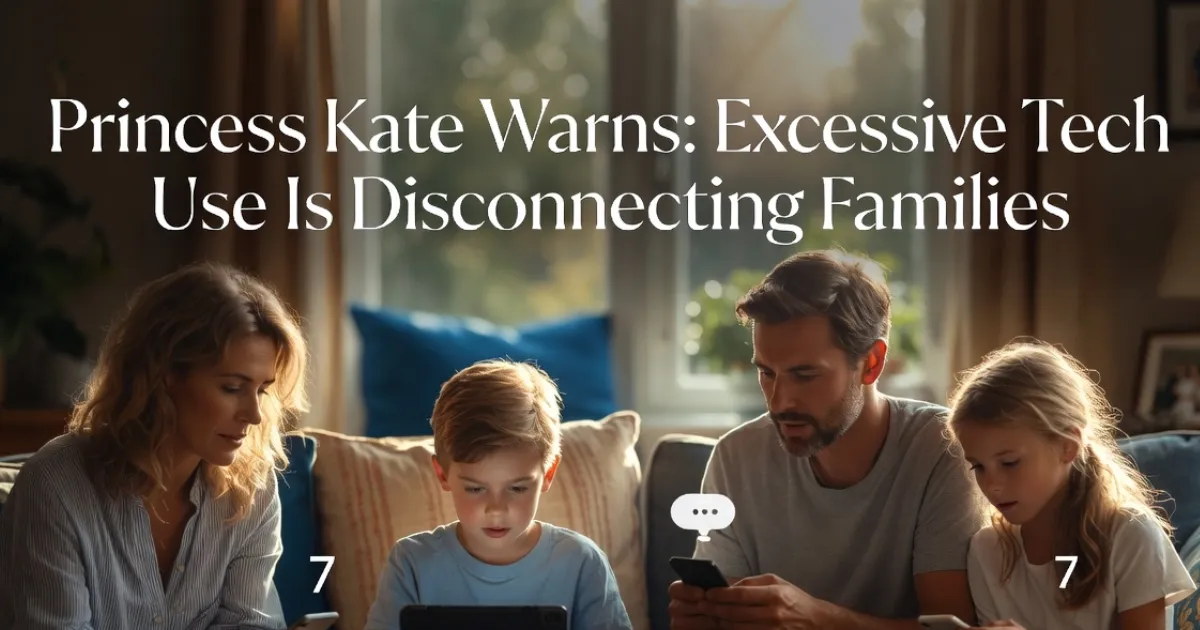
She clarified that this tendency contributes to what she refers to as a “epidemic of disconnection.” Her extensive work with the Royal Foundation Centre for Early Childhood is the source of the message. Warm, responsive relationships are the cornerstone of long-term health and pleasure, according to years of study, including the renowned Harvard Study of Adult Development. Children miss vital moments of eye contact, discussion, and emotional attunement that mold their brains and sense of security when those relationships are broken up by screens. The timing of this warning is crucial. Families must balance the demands of remote learning, work from home, and never-ending notifications. Many parents feel bad about their practices but don’t know how to break them. The hubbub was broken by Princess Kate’s comments. She exhorts us to regain complete focus, which is necessary for the fundamental kind of love connections. Her message is pragmatic rather than dogmatic. She reveals that there are stringent phone-free regulations in her own family. Prince William has acknowledged in public that their kids don’t own smartphones. The royal couple serves as an example of how to reconcile life and technology, not the other way around. Why is this important? Everyone is impacted by disconnection. Through in-person interactions, children acquire social skills. Parents lose out on valuable opportunities for bonding. When digital “connection” takes the place of physical presence, even distant relatives feel more separated. Princess Kate’s caution serves as a reminder that interpersonal relationships are crucial. Her message is thoroughly examined in this essay. Clear explanations, practical examples, a useful comparison table, safe statistics, advantages and disadvantages, step-by-step instructions, and responses to frequently asked questions by parents are all included. By the end, you will have practical strategies to lessen screen time and improve family ties—exactly what Princess Kate promotes.
What Princess Kate Really Said About Family Life and Technology
What Princess Kate Really Said About Family Life and Technology The essay by Princess Kate is straightforward. Smartphones, tablets, and laptops have turned into “sources of constant distraction, fragmenting our focus and preventing us from giving others the undivided attention that relationships require,” according to her: “While digital devices promise to keep us connected, they frequently do the opposite.” She notes that babies and young children born into a digital world face particularly difficult challenges. Their growing brains need for interaction that is sensitive. Children experience less of the back-and-forth that fosters language, empathy, and trust when caregivers check their phones during playtime or mealtime. The Princess connects this to more general patterns of loneliness. Young individuals between the ages of 16 and 24—the generation that was nurtured with continual connectivity—report the highest levels of loneliness, according to research. “Invest in the relationships you have with each other,” she urges society. Crucially, she presents the problem as one of shared accountability. Tech businesses, schools, parents, and caregivers all have a part to play. Her tone remains upbeat: minor adjustments have a significant impact.
How Overuse of Technology Leads to Family Disconnection
How Overuse of Technology Leads to Family Disconnection Family life is impacted by technology in subtle but significant ways. Think about a normal evening. Even if everyone is gathered in the living room, their heads remain buried in their own screens. Discussions become logistical. When notifications interrupt a shared story, the laughter diminishes. Kids take notice. They discover that gadgets are more important than people. Their own habits, like as favoring iPads over board games or texting friends rather than conversing across the dinner table, may result from this modeling. The stress is also felt by parents. Mental exhaustion results from continual checking. Deep listening is diminished by the brain’s quick task switching. Emotional intimacy deteriorates with time. Families say they feel “together but alone.” This disease, which she defined as an unseen gap where physical proximity exists without emotional connection, is specifically referred to as the Princess of Wales separation. Relationships are most negatively impacted by quiet disengagement rather than dramatic disagreement.
Examples of Technology’s Adverse Effects on Family Relationships in the Real World
Examples of Technology’s Adverse Effects on Family Relationships in the Real World Phones at the dinner table are a typical example. Studies reveal that when screens take center stage, families eat together less frequently. Youngsters fail to learn how to take turns and interpret facial emotions. Bedtime routines are another example. Parents scan while kids watch videos instead of cuddling and telling stories. The safety-signaling winding-down ritual vanishes. When parents reply to work emails in the middle of a game, playtime suffers. Over the course of several months, this erodes attachment security because young children understand it as “I am less important than the phone.” Pressure is increased by social media. Parents increase tension rather than happiness by comparing family situations to carefully chosen highlights. Youngsters perceive filtered lives and have feelings of inadequacy. These trends are exactly in line with Princess Kate’s caution: although technology promises connection, it frequently results in isolation.
Comparison Table: Disconnected Tech Habits vs. Mindful Family Practices
| Feature | Description | Benefit | Example |
|---|---|---|---|
| Screen Use During Meals | Phones or tablets at the table | None – fragments conversation | Family dinner interrupted by notifications |
| Mindful Presence | No devices during shared meals | Stronger emotional bonds and better listening | Engaging stories and laughter around the table |
| Bedtime Routines | Screens in bedrooms or right before sleep | Disrupts sleep and connection | Child watches videos alone |
| Device-Free Wind-Down | Reading, talking, or cuddling instead | Better sleep, calmer evenings | Bedtime stories build language and security |
| Daily Check-Ins | Quick glances at phones during playtime | Reduced responsiveness | Parent misses child’s emotional cue |
| 7-7-7 Connection Rule | 7 minutes morning, after school, before bed | Builds consistent attachment | Undivided attention strengthens trust |
| Family Activity Planning | Relying on apps for every outing | Less spontaneous joy | Hiking with phones vs. nature exploration |
| Tech-Free Zones | Designated areas or times without devices | Encourages creativity and interaction | Living room becomes conversation hub |
There are distinct disparities in this table. Measurable increases in family connectedness are produced by slight movements toward the right column.
Statistics on Technology Use and Family Trends
Data on Family Trends and Technology Use The results of recent surveys are consistent. Globally, families are using screens for longer periods of time. Teenagers use screens for more than seven hours a day, while young children (ages 0 to 8) spend about 2.5 hours on average. Many times a day, parents report that phones cut off family talks. 49% of parents use screens as a childcare aid every day, according to a 2025 survey. Although short-term convenient, many acknowledge that it diminishes meaningful relationship. According to global trends, 70% of families report that technology interferes with family time. Lower reported family satisfaction is correlated with phone use at the dinner table. Statistics on loneliness support Princess Kate’s worries. Despite being the most digitally connected age, young adults report the highest levels of isolation. These figures show a common pattern and are not contentious. They highlight the reason her warning is relevant: separation is becoming commonplace rather than uncommon.
Pros and Cons of Technology in Modern Family Life
Technology’s Benefits and Drawbacks for Contemporary Families Advantages
Children can learn letters, numbers, and languages with the use of educational content. Grandparents who live far away can stay in touch through video calls. Apps help families remember significant occasions and plan their schedules. Imagination is sparked by creative tools such as sketching programs. Parents can carefully monitor their children thanks to safety features.
Drawbacks
Regular notifications diminish in-person focus. Overuse replaces outside time and physical play. Social media might exacerbate anxiety and comparing. Parents’ and kids’ sleep is disturbed by late-night scrolling. Children learn to favor gadgets over people when adults model phone usage.
Balance is crucial. In and of itself, technology is neutral. Results depend on how families use it. Princess Kate promotes thoughtful decisions that prioritize interpersonal relationships.
Practical Tips to Reduce Screen Time and Reconnect Your Family
Useful Advice to Cut Down on Screen Time and Bring Your Family Back Together Begin modestly. Start with one modification and work your way up.
Establish device-free areas, such as the dining room and bedrooms. Establish family media agreements: Talk about the guidelines and make them public. When parenting, follow the 7-7-7 rule: Give each child seven minutes of your full attention in the morning, seven minutes when you reunite with them after work or school, and seven minutes before bed. Every day, these twenty-one minutes foster strong connections. Adopt the 3-6-9-12 screen time rule, which states that children should not use screens before the age of three. Before age six, no gaming consoles. Before the age of nine, no unsupervised internet use. Before the age of twelve, avoid social media. Make modest adjustments under supervision. Swap screen time for group activities like cooking, reading aloud, board games, or hikes. Set an example by putting your phone away when you’re with your family. Plan tech-free evenings: Every week, set aside one evening without electronics. Use timers for transitions: Before stopping screen time, give kids a five-minute warning. Celebrate non-digital victories: Give credit for hard work in discussions or imaginative play. Every month, evaluate the children’s development and modify the regulations as they mature.
These pointers are suitable for beginners. They merely need intention and no extra equipment.
Additional Strategies for Busy Parents
Other Techniques for Working Parents Include micro-moments. Making eye contact for two minutes while preparing breakfast is worthwhile. Leave phones in the trunk to transform vehicle trips into conversational moments. Instead of giving out tablets, use waiting areas for activities like “I Spy.” Involve older kids in setting screen time limitations. When teens participate in the creation of regulations, they react more favorably. Keep track of the advantages. Within weeks, families who reduce screen usage frequently report happier moods, fewer fights, and better sleep.
Trending FAQs About Princess Kate’s Warning and Family Life
Popular FAQs Regarding Princess Kate’s Family Life and Warning What is the warning from Princess Kate? Princess Kate cautions that a “epidemic of disconnection” in families is being caused by excessive technology use. She says in her essay from 2025 that smartphones and other gadgets cause people to lose concentration, leaving loved ones physically present but emotionally absent. In order to establish solid partnerships, she demands more focused attention. What is an instance of how family ties are being badly impacted by technology? Phones at the dinner table are a typical example. When family members check their notifications, conversations cease. Over time, children’s emotional relationships deteriorate as they learn that gadgets are more important than shared stories. What is the disconnection of the Princess of Wales? This alludes to Princess Kate’s description of the “epidemic of disconnection.” Because true relationship is replaced by continual digital distractions, families feel alone even though they live together. What impact does technology have on family life? While excessive use of technology can limit face-to-face time, disrupt routines, and model distraction, it can also educate and connect distant family. Princess Kate observes that it frequently stops partnerships from receiving the full attention they require. What is the parenting “7 7 7” rule? According to the 7-7-7 rule, you should give yourself seven minutes in the morning, seven minutes after school or a work reunion, and seven minutes before going to bed. Through constant presence, these 21 minutes a day improve parent-child relationships. Am I the issue, or is my family toxic? Instead of poison, most families deal with typical stress. Small adjustments like device-free periods can assist if screen addictions lead to frequent disagreements or emotional detachment. Prioritize progress over assigning blame. When necessary, expert assistance is helpful. What is the screen time 3 6 9 12 rule? The rule, which was created by French psychiatrist Serge Tisseron, dictates that children should not use screens before the age of three, gaming consoles before the age of six, unsupervised internet before the age of nine, and social media before the age of twelve. Age-appropriate use is encouraged. What are ten drawbacks to technology?
decreased in-person interactions. less exercise. disturbed sleep. Family disputes over screens have increased. Parents and children are less emotionally attuned. Increased loneliness in spite of virtual “friends” Passive scrolling reduces creativity. setting an example of distraction for children. social comparison pressure. short attention spans.
Why are William and Kate sleeping in different beds? Royal sleeping arrangements are the subject of public conjecture, which is frequently connected to custom. Details have never been made public by the couple. Instead than emphasizing personal practices, they openly emphasize family presence and shared parenting beliefs. What disease is Kate afflicted with? In March 2024, the Princess of Wales received a cancer diagnosis and finished preventative therapy. In 2026, she resumed her public activity, including her early childhood projects and this significant essay on family connectedness, while continuing her recuperation. What were Prince William’s three words to Kate? There is no public record of the couple’s private conversations. Support, affection, and cooperation as parents and partners are highlighted in their public statements. In three words, how would Prince Harry characterize Kate Middleton? Prince Harry has discussed family relationships in his interviews and books. Although specific three-word phrases vary by source and are better appreciated in complete context, he has previously used positive expressions like “beloved” or equivalent. Which member of the British royal family is the kindest? There are differences in public opinion. Princess Kate is admired by many for her approachable style, friendliness, and commitment to early children. Personal kindness is demonstrated via the family’s collective public service. William left Kate, but why? Princess Kate and Prince William are still together. They continue to have a happy marriage and prioritize their family and public responsibilities. There is no truth to the rumors. Regarding Kate Middleton, what did Queen Camilla say? Princess Kate has received public support and appreciation from Queen Camilla, who has praised her tenacity and determination in the face of health issues and family obligations. Which royal declined to go to Diana’s funeral? In 1997, no high-ranking royal declined to attend Princess Diana’s funeral. The young princes were supported by their families. Does Meghan Markle need to give Kate Middleton a curtsy? In private situations, royal protocol is adaptable. Tradition dictates public appearances, but the family prioritizes respect for one another over rigorous formality.
Conclusion: Reclaiming Connection Starts Today
Conclusion: Today Is the First Step in Regaining Connection Princess Kate’s caution is a gift—a reminder that families should benefit from technology rather than be divided by it. Her message, which is based on both personal experience and science, demonstrates how little, deliberate adjustments have a long-lasting effect. Perfect behaviors are not necessary. Start with one evening of board games, one 7-7-7 check-in, or one supper without electronics. Observe the return of laughter. See how happy kids get when you give them your undivided attention. Princess Kate’s work and the Harvard Study both attest to the importance of relationships. The biggest benefit is that your family will feel genuinely seen, listened, and loved if you prioritize presence over distraction. This week, take action. During supper, put the phone in a different room. For smaller kids, use the 3-6-9-12 rules. Celebrate each other’s accomplishments. One thoughtful moment is the first step toward a deeper bond within your family. I appreciate you reading. Tell other parents about this page if they’re looking for doable strategies to combat digital separation. By working together, we can transform Princess Kate’s warning into genuine family transformation, one day at a time.


I am a content creator/ Digital Marketor.