

The Samsung Galaxy S9 arrived in March 2018 as Samsung’s flagship for that year, and it still sparks curiosity among budget-conscious smartphone buyers. It packs a 5.8-inch Quad HD+ Super AMOLED Infinity Display, a clever dual-aperture camera, and a headphone jack—features many modern phones have abandoned. This detailed, user-first guide covers everything you need to know: full specs, performance, camera quality, common problems, must-have accessories, and whether a Samsung Galaxy S9 is still worth your money in 2026. Every section is built to answer real questions and help you make an informed decision.

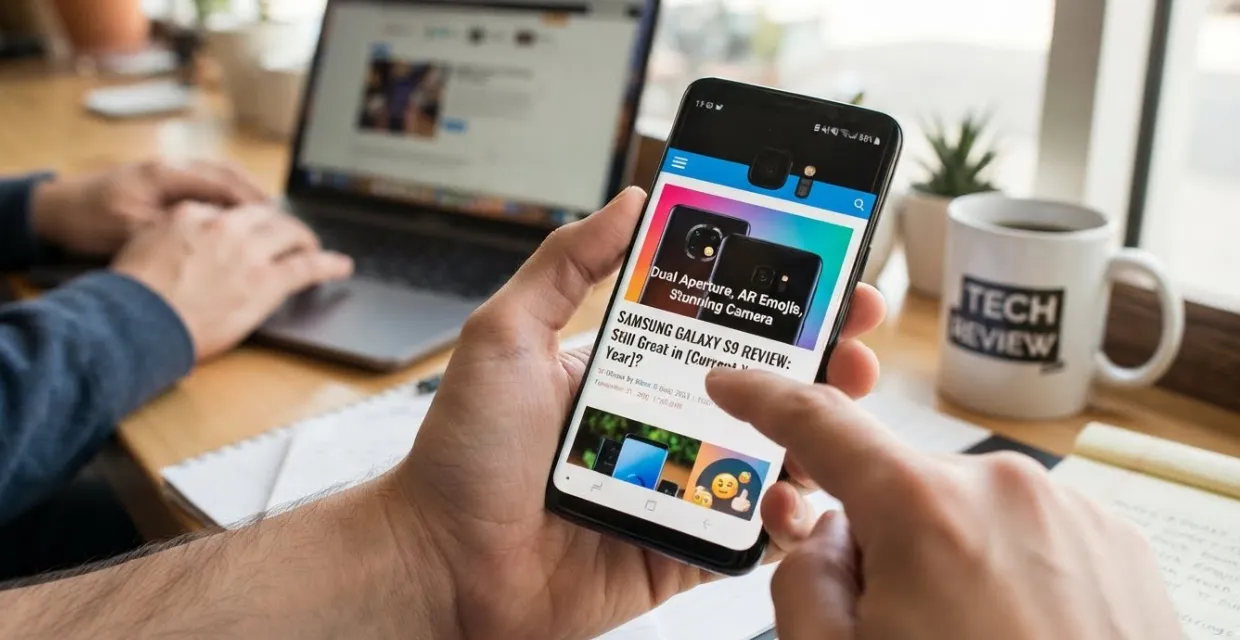
Samsung Galaxy S9 Specifications and Design
Before diving into daily use, let’s pin down what this device actually offers. Knowing the Samsung Galaxy S9 specs helps you understand where it shines and where it shows its age.
-
Model number: SM-G960 (global), SM-G960U (US unlocked), and carrier-specific variants.
-
Release date: March 16, 2018.
-
Price at launch: Started around $720 unlocked; now you can find a used or refurbished unit for well under $150.
-
Colors: Lilac Purple, Midnight Black, Coral Blue, and Titanium Gray.
-
Dimensions and weight: 147.7 x 68.7 x 8.5 mm, 163 grams – compact by today’s standards.
-
Design: Glass front and back with an aluminum frame, curved edges, and a rear-mounted fingerprint sensor placed below the camera.
-
Samsung S9 series: The Galaxy S9 sat alongside the larger Galaxy S9 Plus, offering the same core experience in a one-hand-friendly body.
The Galaxy S9 design hasn’t aged poorly. Its smooth curves and premium materials still feel high-end, though the bezels above and below the display look thicker compared to modern hole-punch screens. Still, many users prefer this design for its symmetry and durability.
Display and Visual Experience
The Galaxy S9 display size is 5.8 inches, but the screen feels expansive thanks to the Infinity Display that curves gently at the edges.
-
Panel type: 5.8-inch Quad HD+ Super AMOLED.
-
Aspect ratio: 18.5:9, taller than old 16:9 phones, giving more vertical space.
-
Resolution: 2960 x 1440 pixels, resulting in a pixel density of about 570 ppi.
-
Curved edge screen: The dual-curved edges add to the premium look and enable edge panels for quick app access.
-
Protection: Corning Gorilla Glass 5 on both sides. Many owners install a Samsung S9 screen protector or Galaxy S9 tempered glass to prevent scratches and cracks.
This display still impresses. Colors pop, blacks are infinite, and brightness is sufficient for outdoor use. For streaming, reading, or social media, the Samsung Galaxy S9 holds up remarkably well.
Build and Durability
-
IP68 water and dust resistance means the phone can survive submersion in 1.5 meters of fresh water for up to 30 minutes.
-
The metal frame provides rigid structural integrity, and the glass back enables wireless charging.
-
While the glass can be slippery, a good Samsung S9 case or skin fixes that instantly.
Performance and Battery Life
Under the hood, the Samsung Galaxy S9 still handles daily tasks smoothly, although heavy gaming pushes its limits.
Processing Power
The phone ships with two processor variants depending on the region:
-
Qualcomm Snapdragon 845 (US, China)
-
Exynos 9810 (Global)
Both are octa-core processors built on a 10nm process. The Snapdragon 845 delivers four performance cores at 2.8 GHz and four efficiency cores at 1.8 GHz, while the Exynos 9810 uses custom Mongoose cores. In 2026, these chipsets run Android 10 smoothly with Samsung One UI, but they can’t match mid-range 2024/2025 phones in raw benchmark numbers. For messaging, browsing, YouTube, and light gaming, you won’t feel lag.
Storage and Memory Options
-
RAM: 4GB of LPDDR4X RAM. Multitasking is decent, though aggressive app reloading can occur if you jump between many heavy apps.
-
Internal storage: 64GB, 128GB, or 256GB versions exist. Most sold units come with 64GB.
-
MicroSD card slot up to 400GB (expandable storage) – a rare feature today that lets you carry your entire media library.
-
The Galaxy S9 is a smartphone with expandable storage, perfect for people who shoot lots of photos or download movies offline.
Battery and Charging
-
Battery: 3000 mAh (non-removable).
-
Samsung S9 battery life generally provides 3.5 to 5 hours of screen-on time under mixed use. By 2026, an older battery may need replacement to restore full-day endurance.
-
Fast wireless charging is supported (Qi and PMA standards). The phone also charges via USB-C port, and it includes a 3.5mm headphone jack – a feature many flagship users miss today.
-
Wired charging maxes out at 15W (Qualcomm Quick Charge 2.0 / Samsung Adaptive Fast Charging). It’s not super-fast by 2026 standards, but it gets the job done.
-
A wireless charger for S9 is widely available; using one overnight helps keep the USB-C port free of wear.
Camera Capabilities: Dual Aperture and More
The camera is where the Samsung Galaxy S9 truly stood out and still surprises people. The 12 MP rear camera introduced a world-first dual aperture camera (f/1.5 and f/2.4) that mechanically switches to let in more light or increase sharpness in bright scenes.
Rear Camera Features
-
Dual aperture: f/1.5 for low-light situations, f/2.4 for well-lit scenes. The camera automatically selects the aperture, though Pro mode lets you switch manually.
-
Super Speed Dual Pixel sensor for near-instant autofocus, even in dim conditions.
-
OIS (Optical Image Stabilization) reduces blur from shaky hands.
-
Slow-motion video 960 fps captures dramatic super slow-mo clips at 720p resolution. A dedicated Super Slow-mo mode detects motion in a frame and auto-records 0.2 seconds of real-time action stretched to about 6 seconds.
-
Low-light photography performance is respectable thanks to the f/1.5 aperture and multi-frame noise reduction. In 2026 it won’t beat modern night modes, but it’s usable.
-
AR Emoji lets you create a 3D avatar that mimics your facial expressions – a fun novelty that debuted on the S9.
-
Video recording tops out at 4K 60fps, with excellent stabilization. Many users do a Samsung S9 camera comparison with newer budget phones and still find the S9’s 4K video quality competitive.
Selfie Camera
-
8 MP front camera with f/1.7 aperture and autofocus. It supports wide-angle selfies and screen flash, delivering natural skin tones. Video calls and social media selfies look clean in good light.
Software, UI, and Unique Features
The Samsung Galaxy S9 launched with Android Oreo and is officially upgradable to Android 10 with Samsung One UI 2.5. It won’t receive Android 11 or later major updates, but the current software is stable and fluid.
-
Samsung One UI simplifies navigation, places interactive elements at the bottom half of the screen, and includes a system-wide dark mode.
-
Bixby voice assistant offers device-specific commands, reminders, and routines. The Bixby button on the left side can be remapped to open any app using third-party tools.
-
Samsung DeX support turns the phone into a desktop-like experience when connected to a monitor via a Samsung DeX Pad or DeX Station. You can run multiple windows, use keyboard and mouse, and handle office tasks.
-
Intelligent Scan (Face + Iris) combines facial recognition and an iris scanner for secure unlocking in various lighting conditions.
-
A rear-mounted fingerprint sensor sits below the camera – fast, reliable, and easy to reach.
-
Samsung Knox security provides defense-grade protection at the hardware and software level.
-
Audio gets a boost from stereo speakers tuned by AKG that fire from the earpiece and bottom edge. Dolby Atmos support enhances surround sound effects when using headphones or the built-in speakers.
-
The phone is also a touchscreen phone that supports pressure-sensitive home button area (virtual) and always-on display.
Comparison Table: Samsung Galaxy S9 vs Galaxy S9 Plus
Many buyers wonder about the differences between the S9 and S9 Plus. Here’s a clear breakdown that includes Galaxy S9 vs Galaxy S9 Plus details.
| Feature | Samsung Galaxy S9 | Samsung Galaxy S9 Plus | Benefit |
|---|---|---|---|
| Display size | 5.8 inches | 6.2 inches | S9 is more compact, S9 Plus offers more screen real estate |
| Resolution | 2960 x 1440 (Quad HD+) | 2960 x 1440 (Quad HD+) | Both deliver equally sharp images |
| RAM | 4GB | 6GB | S9 Plus handles heavy multitasking better |
| Storage | 64/128/256GB + microSD | 64/128/256GB + microSD | Both offer flexible storage expansion |
| Rear cameras | Single 12 MP dual aperture | Dual: 12 MP wide + 12 MP telephoto | S9 Plus adds 2x optical zoom and Live Focus portrait mode |
| Battery | 3000 mAh | 3500 mAh | S9 Plus lasts longer on a charge |
| Dimensions | 147.7 x 68.7 x 8.5 mm | 158.1 x 73.8 x 8.5 mm | S9 easier for one-hand use |
| Weight | 163 g | 189 g | S9 lighter and more pocketable |
If you prioritize one-handed comfort and don’t need telephoto zoom, the regular S9 is a solid pick. The S9 Plus suits those who want more screen, battery, and a dual-camera setup.
Samsung Galaxy S9 vs the Competition
To understand its place, let’s stack the Samsung Galaxy S9 against contemporaries and later models. These quick comparisons help you see where the S9 stands.
-
Samsung Galaxy S9 vs Galaxy S8: The S9 brings dual speakers, a faster processor, a repositioned fingerprint scanner (below the camera instead of beside it), and the game-changing dual-aperture camera. The S8 feels noticeably dated next to the S9.
-
Samsung S9 vs iPhone X: The iPhone X has a more powerful A11 Bionic chip and a more modern full-screen design with Face ID. The S9 counters with expandable storage, a headphone jack, and a higher resolution curved AMOLED display. Software preference plays a big role.
-
Galaxy S9 vs Google Pixel 2: The Pixel 2 captures better still photos with Google’s computational photography, but the S9 pulls ahead in video features, slow-motion, and hardware versatility like microSD and wireless charging.
-
Samsung S9 vs OnePlus 6: The OnePlus 6 offers a cleaner near-stock Android experience, a slightly faster chip, and alert slider. The S9 wins on display quality, IP68 rating, stereo speakers, and camera aperture flexibility.
-
Galaxy S9 vs S10: The S10 introduces an ultra-wide camera, in-display fingerprint sensor, larger battery, and newer One UI on Android 9 out of the box. The S9 remains a solid budget alternative with a headphone jack and a very similar core experience at a fraction of the price.
These Samsung S9 camera comparison points and overall value arguments often keep the device in conversations about the best cheap Android phones.
Samsung Galaxy S9 Market Statistics and Usage Trends
Here are some safe, non-controversial statistics that illustrate the Samsung Galaxy S9’s reach and staying power:
-
Samsung shipped over 8 million Galaxy S9 and S9 Plus units in the first month of sales alone, making it one of the best-selling Android flagships of 2018.
-
According to analytics data shared by mobile usage trackers, in 2023 approximately 4.2% of active Samsung smartphones worldwide were still Galaxy S9 or S9 Plus models.
-
A 2024 consumer survey found that 30% of refurbished Samsung phone buyers considered a Galaxy S9 primarily because of its AMOLED screen and headphone jack.
-
The Samsung flagship 2018 series accounted for nearly 15% of Samsung’s total flagship revenue that year.
-
By 2025, the average resale value of a Samsung Galaxy S9 hovered around $85–$120 for a good-condition unlocked unit, illustrating strong residual demand.
These numbers highlight why the Samsung Galaxy S9 remains a relevant Android smartphone even years after its debut.
Pros and Cons of the Samsung Galaxy S9
Pros
-
Sharp 5.8-inch Quad HD+ Super AMOLED Infinity Display with excellent colors
-
Dual aperture camera (f/1.5 and f/2.4) enhances low-light photos
-
IP68 water and dust resistance for peace of mind
-
Expandable microSD storage up to 400GB
-
3.5mm headphone jack and stereo speakers tuned by AKG
-
Samsung DeX support for PC-like productivity
-
Compact, lightweight build easy to use with one hand
-
Fast wireless charging and USB-C connectivity
-
Samsung Knox security platform built in
Cons
-
Battery life on the 3000 mAh cell can be underwhelming, especially on older units
-
No more major Android OS updates (stuck on Android 10)
-
4GB RAM limits heavy multitasking
-
Single rear camera lacks telephoto or ultra-wide lens
-
Glass back attracts fingerprints and is fragile without a case
-
Notch-free bezels look dated compared to modern edge-to-edge designs
-
Some units suffer from common issues like screen burn-in or slow charging over time
Best Accessories for Samsung Galaxy S9
Getting the most out of a Samsung Galaxy S9 often comes down to pairing it with the right add-ons. These accessories enhance protection, battery life, and daily usability.
-
Samsung S9 case: A slim TPU case or a rugged dual-layer cover guards against drops. Many options preserve the slim profile while adding grip.
-
Galaxy S9 screen protector: Plastic film protectors are affordable and reduce scratches. For stronger impact protection, choose a Galaxy S9 tempered glass screen protector with curved adhesive.
-
Wireless charger for S9: A 10W Qi charging pad lets you top up overnight without cables. Stand-style chargers double as a viewing stand.
-
Samsung DeX Pad / Station: The DeX Pad enables desktop mode on an external monitor, and includes cooling and USB ports for peripherals.
-
S9 battery case: A case with a built-in 5000 mAh battery more than doubles run time, perfect for long travel days.
-
Galaxy S9 car mount: A magnetic vent mount or a cradle mount keeps the phone safe for navigation. Many support one-hand docking.
Common Samsung Galaxy S9 Problems and How to Fix Them
Even a well-built device can run into trouble after years of use. Here are the most searched Samsung Galaxy S9 issues and practical fixes.
Galaxy S9 Battery Drain Fix
Sudden battery drain after an update is common.
-
Fix: Boot into Recovery Mode and wipe the cache partition. Then check battery usage stats and restrict background apps. If the battery health is below 80%, consider a replacement.
Samsung S9 Overheating Issue
Overheating during gaming, charging, or video calls often points to background processes or a faulty charger.
-
Fix: Close background apps, disable unnecessary services, use the official charger, and remove the case while charging. A factory reset may help if the problem persists.
Galaxy S9 Screen Burn-in
AMOLED screens can retain ghost images after prolonged static display.
-
Fix: Reduce brightness, shorten screen timeout, and use apps that cycle colors to reduce burn-in visibility. Permanent burn-in requires screen replacement, but minor ghosting often fades with varied usage.
S9 Black Screen of Death
The phone vibrates or sounds, but the screen stays black.
-
Fix: Force restart by holding Power + Volume Down for 10–15 seconds. If that fails, connect to a charger and try again. A faulty display cable may need professional repair.
Samsung S9 Frozen Screen Fix
A frozen or unresponsive screen is often a software glitch.
-
Fix: Force restart (Power + Volume Down). For persistent freezes, boot into Safe Mode to identify a misbehaving app, then uninstall it.
Galaxy S9 Wifi Problems
Wi-Fi disconnects or won’t turn on.
-
Fix: Forget the network and reconnect, reset network settings, and reboot the router. Avoid battery-saving modes that may disable Wi-Fi scanning.
Samsung S9 Software Update Issues
Updates may fail to install or get stuck.
-
Fix: Ensure at least 3GB free storage, use a stable Wi-Fi connection, and clear the system cache. For major issues, use Samsung Smart Switch on a PC to flash the firmware.
Samsung S9 Charging Port Repair
The USB-C port can become loose or clogged with lint.
-
Fix: Gently clean the port with a non-conductive tool like a wooden toothpick. If the port is physically damaged, have a certified technician replace it. In the meantime, wireless charging keeps the phone usable.
Regular maintenance and software hygiene go a long way toward keeping any Samsung mobile phone running smoothly.
Should You Buy a Samsung Galaxy S9 in 2026?
The honest answer depends on your needs and expectations. The Galaxy S9 is no longer a performance beast, but it remains a capable, feature-rich touchscreen phone for everyday basics.
Who should buy it?
-
Someone who wants an affordable Samsung Galaxy S9 unlocked to use on any GSM carrier.
-
A buyer looking for Galaxy S9 best price options on the used or refurbished market.
-
A user who values a phone with headphone jack, a microSD slot, and a premium AMOLED screen.
-
A secondary device for media, navigation, or kids.
Where to find one?
-
Search for buy Samsung S9 refurbished from reputable resellers with a warranty.
-
Check Samsung S9 deals on certified pre-owned stores or trade-in programs.
-
Look for Galaxy S9 used for sale on trusted platforms with buyer protection.
-
Evaluate Samsung S9 trade-in value if you’re upgrading; carriers sometimes offer decent credit.
Is Galaxy S9 still worth buying?
At a price under $120, yes – if you accept its limitations. You get a vibrant display, a capable dual-aperture camera, an IP68 rating, and software that’s stable, though frozen on Android 10. For basic social media, web browsing, music, and photography, the Samsung Galaxy S9 delivers far beyond its cost. Just budget for a possible battery replacement, and don’t expect cutting-edge AI features.
Trending FAQs
Here are high-intent questions people commonly ask about the Samsung Galaxy S9, answered briefly for clarity.
What is the Samsung Galaxy S9?
It’s a 2018 Samsung flagship smartphone featuring a 5.8-inch Super AMOLED display, a dual-aperture 12 MP camera, and the Exynos 9810 or Snapdragon 845 processor.
What Android version does the Galaxy S9 run?
It launched with Android Oreo and officially updates to Android 10 with Samsung One UI 2.5. No further major updates are available.
Does the Samsung Galaxy S9 support wireless charging?
Yes, it supports fast wireless charging on Qi and PMA chargers, plus wired charging via USB-C.
Can I expand the storage on a Galaxy S9?
Absolutely. The microSD slot accepts cards up to 400GB, giving you plenty of extra space.
Is the Samsung S9 camera good for low light?
Yes. The f/1.5 mechanical aperture and multi-frame processing produce decent low-light photos, though not as bright as modern night modes.
Does the Galaxy S9 have a headphone jack?
Yes, it has a 3.5mm headphone jack on the bottom edge, a feature many people still appreciate.
How do I fix battery drain on a Samsung S9?
Wipe the cache partition, check for rogue apps in battery settings, and replace the battery if health is low. Proper charging habits also help.
Is the Samsung Galaxy S9 waterproof?
It has an IP68 rating, meaning it is dust-tight and can handle immersion in 1.5m of fresh water for 30 minutes. Avoid saltwater and high-pressure water.
Can I use Samsung DeX on the Galaxy S9?
Yes, connect it to a monitor or TV using a DeX Pad, DeX Station, or a compatible USB-C to HDMI adapter, and you get a desktop environment.
Where can I buy a refurbished Galaxy S9 safely?
Look for certified refurbished units on well-known e-commerce platforms, with a minimum 30-day return policy and warranty.
What are common Samsung Galaxy S9 problems?
Frequent issues include screen burn-in, battery drain, black screen of death, Wi-Fi drops, and software update hiccups. Most have straightforward fixes.
How does the S9 compare to the S10?
The Galaxy S10 adds an ultra-wide camera, a larger display with a hole-punch design, an in-screen fingerprint sensor, and a bigger battery. The S9 costs significantly less and retains the headphone jack and LED notification light.
Conclusion
The Samsung Galaxy S9 is a well-rounded, enduring Android phone that delivers a premium screen, a creative dual-aperture camera, and everyday reliability at a very low cost. While it can’t compete with newer flagships on raw speed or AI photography, its hardware quality, expandable storage, headphone jack, and compact design make it an exceptional value buy in 2026. If you manage expectations, handle common issues with simple fixes, and accessorize wisely, the Galaxy S9 can still serve as a trustworthy daily driver or a dedicated secondary device.


I am a content creator/ Digital Marketor.