Overview
For anyone who enjoys creativity, beauty services, and flexible work schedules, becoming a nail technician in Pennsylvania can be a fulfilling career choice. Nail care is still one of the most sought-after services in salons and spas around the state, and the beauty sector is still expanding. This comprehensive guide will bring you through every step, prerequisite, cost, timetable, and career tip you need to know if you’re wondering how to become a nail tech in Pennsylvania.
Following Google’s quality requirements, this article is written in plain, easy-to-read language and offers reliable, practical information for students, career changers, and anybody wishing to work in Pennsylvania’s beauty industry.
What Are the Duties of a Pennsylvania Nail Technician?
A nail technician is an expert in both nail art and nail care. Among their responsibilities are:
Giving pedicures and manicures
Putting on nail extensions, gels, dips, and acrylics
Creating nail art designs
Upholding norms of cleanliness and hygienic practices
Teaching customers about nail care
Providing soothing spa-like services
In addition to the opportunity to work in salons, spas, home-based enterprises, or even mobile nail salons, this vocation offers creativity and freedom.
Qualifications for Nail Technicians in Pennsylvania
Minimum Standards for Eligibility
You have to:
Be sixteen years of age or older
Possess a 10th grade education or its equivalent
Complete the necessary apprenticeship or training hours
Be successful on the state license test
Send the Board an application together with the required payments
These regulations guarantee that all professionals in the state adhere to hygienic and safety standards.
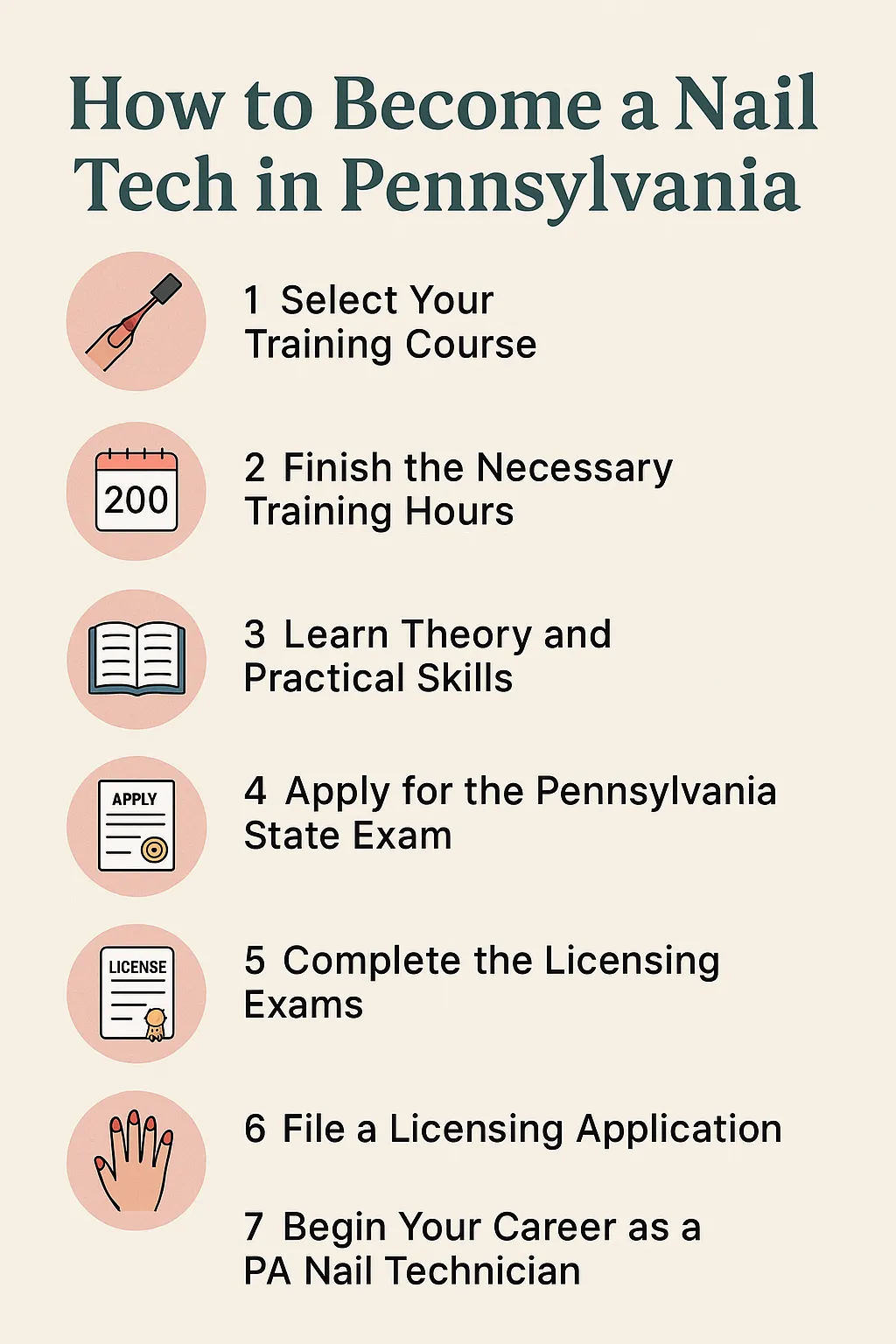
Detailed Guide: How to Work as a Nail Technician in Pennsylvania
This is a detailed explanation of the entire procedure.
Step 1: Select Your Training Course
There are two choices available to you:
Option 1: Program for Nail Technicians (Preferred)
A cosmetology school with PA approval provides organised, practical instruction.
Choice 2: Apprenticeship Path
You can receive instruction from a qualified expert.
Step 2: Finish the Necessary Training Hours
In accordance with PA regulations:
200 hours for a nail technician licence
1,250 hours are required for a cosmetologist licence (an optional alternative path)
Since the 200-hour nail tech program is quicker and more concentrated, most students opt for it.
Step 3: Learn Theory and Practical Skills
Typical training consists of:
Concept
The anatomy and structure of nails
Disorders and diseases (non-medical summary)
Sanitation, hygiene, and safety
Chemistry of the product
State regulations and laws
Useful Skills
Both pedicures and manicures
Sculpting nails
Dip systems and gel polish
Application of building gel and acrylic
Design and nail art
Customer service and advice
Before working with actual clients, practical training helps you gain confidence.
Step 4: Apply for the Pennsylvania State Exam
After training is finished, the Board receives documentation from your mentor or school.
After that, you can apply for:
The theoretical test
The hands-on test
Instructions for setting up your test date will be sent to you.
Step 5: Complete the Licensing Exams
In Pennsylvania, passing two tests is required to become a licensed nail technician:
1. Exam of Theory
Covers:
Cleanliness
Safety of clients
PA regulations
Product expertise
Nail techniques
2. Exam in Practice
You’ll show:
Setup for disinfection
Steps for a manicure
Sculpting nails
Applying tips or creating sculptures
Simple application of nail polish
You can obtain your official licence if you pass both tests.
Step 6: File a Licensing Application
Following your exam success:
Send in the application
Pay the licence costs
Upload the necessary files
Your licence is mailed to you, and processing is often completed quickly.
Step 7: Begin Your Career as a PA Nail Technician
You are now prepared to:
Work in salons
Join nail salons or spas
Launch a mobile nail salon
Launch a home-based business (with the required permits)
Rent a salon booth
Experience and increased abilities increase your earning potential.
Comparison Table: Apprenticeship vs. Nail Tech Program in Pennsylvania
Benefit, Example, Feature, and Description
Training Type: Online and in-person classes with a structured learning program
Hours: 200 hours are required; a quicker completion time of 8–12 weeks
Cost: Tuition costs vary, with financing options ranging from $2,000 to $5,000
Apprenticeship: Learn real salon work from real paying clients while working under a professional technician
Pay: Earn while training with weekend shifts over a duration of 6 to 9 months
Ideal For: Newcomers or those changing careers, with clear guidance for students seeking stability
Safe and Practical Statistics (Non-YMYL)
Here are some insightful, non-sensitive observations regarding the nail industry:
The nail care industry is growing steadily each year, averaging between 4% and 6%
More than 82% of American customers buy nail care products at least once a year
Gel and acrylic services are consistently in demand, according to PA nail salons
In Pennsylvania, almost 60% of newly hired nail technicians work part-time during their first year
Appointment-based services are preferred over walk-ins by over 70% of clients
Strong long-term opportunities are indicated by these broad industry trends.
How Much Time Does It Take in Pennsylvania to Become a Nail Tech?
A typical timetable:
One to three months of training
Exam time: two to six weeks
Approval of licence: 1–3 weeks
Final procedure: three to five months on average
How Much Does a PA Nail Tech School Cost?
The majority of nail tech programs cost:
$2,000 to $5,000 in total
This could consist of:
Cost of tuition
Tools and kit
Books
Exam costs
Fees for licensing
Although the duration of an apprenticeship is longer, the expenditures are typically lower.
Renewing a PA Nail Tech License
Every two years, you have to renew.
Renewal entails:
Making the renewal payment
Maintaining current contact details
Observing all sanitary regulations set forth by the state
Benefits and Drawbacks of Working as a Nail Tech in Pennsylvania
Advantages
brief training time
Reasonably priced admission into the workforce
High demand for spas and salons
Adaptable timetable
Possibility of artistic expression
Potential for independent work or home-based services
Drawbacks
Physical tension on the back and hands
Demands regular hygiene procedures
Seasonal variations in income are possible
There may be lengthy and hectic days
Continuous training is required for emerging trends
Pennsylvania Career Prospects for Nail Technicians
Once you get your PA license, you can work as:
A nail technician
A nail artist
Specialist in spa nails
Renter of a salon booth
Mobile nail artist
Trainer or instructor (with experience)
Owner of a salon
Competencies Required for Nail Technician Success
Accuracy and originality
Excellent hand-eye coordination
Excellent communication abilities
Understanding of gel, acrylic, and dip nail systems
Customer service
Order and cleanliness
Knowledge of business
Typical Errors Novices Make
Hurrying through the training
Disregarding hygienic regulations
Purchasing subpar equipment
Undercharging customers
Not enough practice
Not maintaining client records
Ignoring higher education
Top Strategies for Succeeding as a PA Nail Technician
Create a solid portfolio
For consistency, practise every day
Discover popular methods
Attend classes on gel and acrylic augmentation
Provide outstanding client service
Make quality and cleanliness your selling points
Use social media to advertise your work
Attend classes or beauty events in your community
Follow the state regulations in Pennsylvania
Upcoming Developments in the Nail Industry
Growth in services for nail wellbeing
Growing demand for eco-friendly and vegan products
A rise in the need for mobile nail technicians
More customers looking for personalised artwork
Intelligent tools for nail design and cure
Demand for virtual nail try-on applications is rising
Frequently Asked Questions Concerning Becoming a PA Nail Technician
1. In Pennsylvania, how many hours are required to become a nail technician?
You must complete 200 hours of training at an authorised apprenticeship or licensed school.
2. How long does it take to complete Pennsylvania nail tech school?
The majority of programs last one to three months, depending on the school and timetable.
3. In Pennsylvania, is a licence required to do nails?
Indeed. To provide professional services, a nail technician must have a current licence from the state.
4. Is it hard to become a nail technician?
With the right training, it is doable. Your speed, accuracy, and technique all increase with practice.
5. What is the salary range for nail technicians in Pennsylvania?
Location, clientele, and service costs all affect revenue. The majority are paid by commission, service fees, or hourly salaries.
6. Can I do nails at home in Pennsylvania?
Yes, however you have to have the right permissions and adhere to the state’s regulations for home-based salons.
7. What distinguishes a cosmetologist from a nail technician?
A cosmetologist studies hair, skin, and nail treatments, whereas a nail tech solely studies nails.
8. Is it possible to learn nail art before going to school?
Indeed. You learn more quickly if you practise designs early.
9. Does Pennsylvania require ongoing education for nail technicians?
Although it’s not necessary right now, remaining current aids in your professional development.
10. Does Pennsylvania offer an apprenticeship program?
Although it could take longer, it is possible to receive training from a licensed expert.
11. Can I attend nail tech school with financial aid?
Some educational institutions provide private financing options or payment plans.
12. Does PA permit training for nail technicians online?
Hands-on hours must be performed in person, but theory can be done online.
In conclusion
A clear and attainable career path that provides creativity, flexibility, and steady demand is becoming a nail tech in Pennsylvania. You may establish a fulfilling career in the beauty industry with just 200 hours of training, the appropriate schooling, and state certification. There are many chances for growth and success in Pennsylvania, regardless of your goals—working in a salon, starting a home-based business, or providing mobile nail services.
The beauty industry always rewards commitment and ingenuity, so follow the steps in this guide, maintain consistency in your practice, and invest in your expertise.

I am a content creator/ Digital Marketor.